Showing posts with label Author Interviews. Show all posts

Monday, July 9, 2012

TWFT Launch - with awesome interview from Chanelle Gray!

Teens Writing For Teens and the new site have been up for a bit now, but we've decided it is time to give the site an official launch. Because we're teens (or teens at heart!) we like to do things big, so we've created some launch festivities that will hopefully knock your writerly socks off.

For one, we have a super awesome interview with YA and Twifty author Chanelle Gray! Her book, My Heart Be Damned, drops on September 15th. I read this book and can assure you all it is fantastic.

One top of the interview, Chanelle has offered to give away an E-ARC of My Heart Be Damned!

To make it super special, TWFT is throwing in a $25 Amazon gift card.

To enter for a chance to win the E-ARC and the gift card, you must follow our blog (followers widget is at the bottom!) and comment on this post. Extra entry for tweeting about the contest and showing proof in the comment section. Maximum of those two entries (1 comment and 1 tweet entry) per follower!

Comments can simply be "I want to be entered in the contest," but we prefer awesome praise for Chanelle (just saying). 

Now, without further ado: Chan's Interview!

~
Tell us about young Chanelle! How old were you when you first started writing? Were you an avid reader? What sort of things did you read/write?  
 Oh this is a hard one. I think I was around ten or so when I started to write. It was whenever I began actively reading, and not just reading what school told me to. I remember, the first book I ever made my mum go and buy me was Harry Potter. We started reading it at school and I was hooked. From then on, I visited book stores and bought books for myself with my pocket money. I don't remember the exact moment I thought 'I can do this!' but it happened! I started off writing (bad) fanfic, and it bloomed from there!
-
How do you know if a great idea you have should become a short story or a novel?  
 I don't do short stories! My answer above is testament to that. I've never had to distinguish between a novel and a short story. They're all novels!
-
 How do you get past bumps in the writing road… when you want to do anything but write?  
 If I know the story has merit and I'm just at a sticky scene, I will write my way through it. I'll force the words. I can always go back and rewrite, but if I don't make myself get past that bump, I never will. I'll give up and start something else. Having to write a sequel has taught me a big lesson in pushing through and writing what you can. There is no moving onto another manuscript. It has to be done.
-
What was your inspiration for MHBD?  
Anyone whose read an early proof of MHBD will be reminded of Buffy. I grew up watching Buffy. I lived and breathed and ate Buffy (well, not really, but you get my point!). I've longed for a book like it for years and years. Even another TV show or film. There's nothing at all similar. So I thought I'd do it myself! MHBD isn't a Buffy re-write, but it's definitely inspired by Buffy's kick-ass characteristic and her trying to live in two worlds. I find it fascinating.
-
We love representation stories here at TWFT. How did you find your awesome agent? Any tips on perfecting a query letter? 
 I found Victoria the long way - the slush pile. There was no question about signing with her. Talking on the phone to Victoria was so surreal and so amazing. I've never regretted my decision since. My one tip for a query letter though is to make it interesting. Imagine being an agent. Imagine having to read hundreds of queries a day. You need to make yours stand out. My simple technique is to write your query with three parts. Part 1: Brief introduction to the world, your character, and the story. Part 2: Briefly describe the build up of your story. The issues your character is facing. Part 3: End with a bang. Your stakes should go here. 
-
And of course…. What is your favorite Jellybean flavor?  
No! This is too difficult! Erm...watermelon?!

~

Chanelle is a superstar, no doubt about it. Now enter the contest!

a Rafflecopter giveaway

Thursday, June 14, 2012

Interview with author Ann Stampler

Today we introduce Ann Redisch Stampler, a picture-book author who has just recently made her foray into young adult fare. When browsing through books on Goodreads, the cover of WHERE IT BEGAN caught my eye immediately (you'll have to thank Ann's amazing cover designer, Jessica Handelman, for that!). Here's the back-cover copy for WHERE IT BEGAN:
"Gabby Gardiner wakes up in a hospital bed looking like a cautionary ad for drunk driving—and without a single memory of the accident that landed her there. But what she can recall, in frank and sardonic detail, is the year leading up to the crash.
As Gabby describes her transformation from Invisible Girl to Trendy Girl Who Dates Billy Nash (aka Most Desirable Boy Ever), she is left wondering: Why is Billy suddenly distancing himself from her? What do her classmates know that Gabby does not? Who exactly was in the car that night? And why has Gabby been left to take the fall?
As she peels back the layers of her life, Gabby begins to realize that her climb up the status ladder has been as intoxicating as it has been morally complex...and that nothing about her life is what she has imagined it to be." I'll bet that caught your attention. Read on for the process behind the product.


TWFT: Where were you when you found out WHERE IT BEGAN sold?

Ann: I was at home, waiting to hear from my agent, Brenda Bowen. I knew there was strong
interest in the manuscript, but I wasn’t sure of the final outcome. Then the phone rang,
followed by a great deal of squealing by me, my husband, and my dog.


TWFT: Why YA?

Ann: I have to preface this by saying that I don’t understand fully what makes one book with
a teenage protagonist YA and another one not.

With Where It Began, I started out with the character of Gabby; her voice and her
emotions felt very real to me as I was writing. I wasn’t aiming the book at a particular
audience, I just wanted to tell the story, but I’m very happy to join the genre of YA, and
that teens are reading the book.

TWFT: Assuming that you are a writer of the social kind (critiquing other work, networking),
you’ve run across your fair share of people who’ve made it and people who are still
struggling to earn recognition. What sets apart these successes from the not-so-
successful?

Ann: What a difficult question.

I think there has to be some connection between quality and recognition. There are
books that are just so brilliant that, if there’s any justice in the universe, they’ll be
embraced. And others, not so much.

But especially with the advent of the internet and book-related social networking, it’s
increasing clear that not every book is for every reader, irrespective of what traditional
literary critics may think. There is a healthy contingent of people who aren’t all that
crazy about books I consider touchstones of English literature (On Goodreads, for
example, Shakespeare’s Romeo and Juliet has 3.73 out of 5 stars.)

So the question becomes whether recognition is, in fact, related to quality or to
other factors. And who determines what constitutes quality, anyway? Or what we’d
consider recognition: wide readership, literary awards, respect among other writers,
timelessness, what?

As ways to publish and read books proliferate, along with book-related conversations
and blogs that can be accessed by the entire world of plugged-in readers, a question
that was hard enough to confront in the pre-internet era, becomes even thornier.
 
TWFT: A lot of writers, myself included, have various trunked novels buried deep without their closets. When do you know your work is ready?
I am a constant, ongoing, compulsive rewriter. So for me, the answer is never. I don’t
mean this in a flippant way; I would go back and rewrite all of my picture books if I
could. Not to mention what I’d do with 384 pages of Where It Began to toy with.

I push the “send” button on manuscripts with a certain amount of trepidation. I’m
never sure I’m there.

The “you’ll just know” answer feels a bit glib, but it’s as close as I can get for how I
decide to push the button.


TWFT: Sometimes it feels frustrating when you’ve been struggling for a while and your peers
are getting published—I like to use the metaphor of climbing up a mountain fighting
tooth and nail while seeing someone fly up to the peak via helicopter. How do you deal
with jealousy?

Ann: When I was writing picture books, I really didn’t have issues with jealousy. I spent
almost a decade waiting for my first PB to see the light of day, and I was pretty much
whistling a happy tune, raising kids, and reading a lot of folklore the whole time. I was
annoyed occasionally, but I was absolutely smug about how well I could handle waiting
and chipping away and rejection.

And then came the novels, and for some reason, it’s a lot more emotional. Not just
the process of writing the book, and experiencing the characters’ emotions, but the
aftermath of publishing the book. It feels both more personal and more public; I feel
much more exposed and more judged, more aware of what’s going on with other
writers and of how others see me and my work.

The way I’ve come to deal with it – and I’m writing this just a couple of months after
the release of my first novel, Where It Began – is to stay focused on the work. (This has
been greatly facilitated by the fact that my next novel was overdue until I finished it last
week, and it’s been commanding most of my waking hours and attention.)

In most other careers, issues of fame/fortune/recognition/public evaluation/prizes are
less salient; as the product of people’s work is less public. Satisfaction is derived from
the work itself.

With writing, especially with children’s books, the constant and very public evaluations,
reviews, comparisons to other books, sizes of advances, best lists, etc. can be
distracting. But the bottom line is, I like what I’m doing. I like the process of writing
books, and the process of revising them. I like working with my agent, my editor, and
the team at Simon Pulse. I’m happy that my books are published and that there are
readers who connect with them. That’s enough.


TWFT: How do you find the time to write—and to write well? (I can sit down at my desk,
scribble for a few hours, read the words the next morning, and find nothing I’m
particularly proud of.)

Ann: In terms of the writing well thing, I am a great believer in Anne Lamott’s theory of the
truly terrible first draft. So what if you hate it in the morning, or the next morning,
or the next morning (and by “you,” I mean me, too, as this is my m.o.)? That’s what
rewriting is for. That whole if-there’s-nothing-on-the-page-there’s-nothing-to-revise
thing: it works.

For me, at least, it’s important not to tie my global assessment of myself as a writer, or

the quality of a manuscript, to that morning-after perusal. If I couldn’t do that, I suspect
I’d be too humiliated by un-rewritten chaff to carry on.

In terms of time to write, I wrote picture books until the day my youngest child left
for college. I think because with a PB, I could hold the whole thing in my head and
do lots of work in my mind’s eye. I could do meaningful rewriting in an afternoon, as
opposed to making a change and then having to peruse the other 374 pages to make
sure everything still works with a novel.

With novels, although I wrote bits and pieces of them before I had the luxury of huge
blocks of time, I find that particularly when I’m revising, I need to reread the whole
thing, or at least a significant section of the whole thing, slowly and carefully, before I
dig in. So while a few hours here or there works for me at some stages of the novel, I
don’t know how I’d manage without whole days and nights at others.


TWFT: What’s one thing you learned now that you wish you should have learned before the
whole process?

Ann: Patience. It takes far longer than anticipated to get it right. And for it to be edited
properly. And to get it launched well. I started Where It Began in a serious way the day
my youngest entered college; it came out two months ago; and my son just graduated!


TWFT: What’s your favorite flavor of jellybean?

Ann: Oh dear, I don’t actually like jellybeans. I don’t see how people can even consider eating
jelly beans in a world full of chocolate: chocolate cupcakes, Droste semi-sweet pastilles,
Hershey’s kisses, flourless chocolate cake, chocolate soufflé, chocolate cream pie, and
the entire Godiva Chocolate empire. I mean, seriously? (And don’t point to chocolate
jelly beans. Chocolate jelly bean. Godiva milk chocolate truffle. I rest my case.)

Although, I guess if I had to eat a jelly bean, it would be sourish lemon.

Wednesday, May 30, 2012

YA Author Anna Banks discusses the publishing world of tomorrow


Recently, TWFT asked Anna Banks, author of the recently-released OF POSEIDON, to write about how she envisions the publishing world of tomorrow. Here’s what she said.

~

To get a good idea of where the future of publishing is going, let’s examine some facts:

Fact #1 Ebooks are here to stay. (Until the zombie apocalypse, that is. Then we’ll all have to read print books, because our e-readers will eventually run out of juice).

Fact#2 Ebooks have hurt the sales of print books. (Though to what extent we can’t be sure because perhaps you’ve noticed we’re also in the belly button of a crappy economy).

Fact#3 It is relatively easy to self publish an Ebook. Hence, there are a lot—a lot—of self published Ebooks out there. (Insert your opinion about that here).

Now, you might think you know where I’m going with this, but you’re probably wrong. If you think I’m against Ebooks or self publishing or the zombie apocalypse, you’re so very adorably mistaken.
Repeat after me: Ebooks are not the devil. Not even self published ones.
Before I got an agent and a book contract, I was a snob about self publishing. I told myself that I would never do it, that if my work wasn’t good enough to get picked up by a traditional house, then it simply was not good enough.

The truth is, I would self publish. Please note that my debut novel, OF POSEIDON, has been picked up by one of the “big six” publishing houses, Macmillan. They’re even sending me on book tour this summer. I have a rock star agent. A publicist, even. All the doors appear to be open to me, right?  So why would I, an author who has already “made it”, consider self publishing?

After going through the publishing process, I’ve changed my mind. Here’s why:

Let’s say I have an idea for a book that I lurve (right now, this is hypothetical, but it could very well happen at some point), or that I’ve already written this book that I lurve. Let’s say my editor doesn’t like it. OR let’s say a bunch of editors like it, but they want changes I’m not willing to make. (This happens all the time, BTW. Usually the author and editor will compromise, but sometimes their vision for the book is too far apart to come to an agreement.) Do I drop the book, this idea that I love and work on something we can all agree on?

Not necessarily. That is, not unless I absolutely want to earn an advance and have the marketing handled for me and the cover designed for me and a book trailer made for me and a tea party with lemon crumpets in my honor (ßI made this last part up). And just for the record, I *do* want all these things. These things are ideal. These things are nice. These things are fancerous.

But what if I still feel very strongly about my own vision for the book? Will I format it and slap it on Amazon first chance I get, then tweet the snot out of it until I’ve irritated all my followers?

Some might. Some do. Okay, a lot do. That’s where the Ebook gets its horns and pitchfork, I’m afraid. But not me. Nope, I’m hiring a freelance editor who will clean it up, critique it, and send it back to me all purdy. Then I get to worry about marketing and covers and book trailers and tea parties with lemon crumpets. Is it worth the trouble and money to do all this? That of course, depends on how you feel about your book. If I loved it enough though, I would do it.

Does that mean I’ve declared the traditional publishing industry an enemy? Am I a traitor? Does it mean I’ll stop writing books for my agent to submit to editors? Does it mean I’m no longer a legitimate writer?
Heck to the no. It means I love a story enough to breathe life into it at my own expense. And what’s wrong with that? I’m investing in myself. Period. Plenty of traditionally published authors are open to self pubbing. Plenty are opposed. All have fans.

Here is my question to you: As a reader, would you refuse to read a self published work by your favorite author? Why or why not? Would you take a chance on an unknown self published author?
Because your answers, my friends, are precisely what determine where the future of the publishing industry is heading.

 ~

Thanks, Anna! If you want to read more of her writing, you can visit her blog. You can also buy her book here.

-
Linda

Tuesday, May 22, 2012

Interview with Upcoming YA Author Erin Jade Lange


TWFT has had the pleasure of talking to Erin Jade Lange, author of the upcoming Bloomsbury YA novel BUTTER, about an overweight boy who plans on eating himself to death in front of millions of online viewers. In the following interview, Erin dishes on writing, publishing, and the whole learning process. Enjoy!

TWFT: Where were you when you found out BUTTER sold?

ERIN: I can’t remember the exact moment when we accepted, and it was a “done deal,” because there was a bit of a process leading up to that.
But the moment that stands out for me is when I first learned an offer was incoming. I had just stepped off a plane in my home town for a visit. As soon as I turned on my cell phone, it started blowing up with messages from my agent, who had been trying to reach me while I was in flight. There was a lot of frantic texting, and then I just remember standing in the airport parking lot and looking up at my parents in shock and saying something along the lines of, “I think someone’s going to publish my book.”

TWFT: Why YA?

ERIN: The first novel I ever attempted to write was for adults. Looking back at it now, it has the pace and voice of YA and even a fairly “young” adult narrator, but I wasn’t even thinking about what I was writing at the time. I was just getting my feet wet. Then the Harry Potter craze came along, and I rediscovered YA and MG books.
Over the next few years, I shopped mostly in the teen section and rediscovered everything I had loved about young adult books growing up. I could see they not only influenced my writing style but also shaped who I was as a person at a critical time in my life. Those were the kind of books I wanted to write.
Also, it helps that my inner voices are mostly angsty teenagers.

TWFT: Assuming that you are a writer of the social kind (critiquing other work, networking), you’ve run across your fair share of people who’ve made it and people who are still struggling to earn recognition. What sets apart these successes from the not-so-successful?

ERIN: This is a really tough question to answer, because it depends on how you define success. I know people at every stage of the publishing process, from writing a first book to hitting a bestseller list. I think of them all as successful because to me, success is just about setting a goal, achieving it, setting the next goal, rinse and repeat.
But I do think all authors who have achieved any amount of success have one thing in common – commitment. They’ve survived rejections or bad reviews. They’ve trunked beloved stories and moved on to the next project. They keep reaching. Most authors who seem successful have a NEVER QUIT attitude.
Coming out September 18 to a bookstore near you!

TWFT: A lot of writers, myself included, have various trunked novels buried deep without their closets. When do you know your work is ready?

ERIN: I’m better at knowing when it’s NOT ready. I often abandon projects or never get around to editing the first draft, because I’ve lost passion for them… which is just my fancy way of saying I get bored. And if I’m bored, the reader will definitely be bored.
When I do like something enough to send it to my crit partners, I tend to rely on feedback from that point on. Several rounds of revisions later, when my beta audience is happy with it, and I’m sick of looking at it, it’s probably ready.

TWFT: How do you deal with jealousy–say, when you’ve been struggling for a while and everyone else is getting published?

ERIN: This goes back to setting personal goals and defining your own success. If I see someone achieving something I’d like to achieve, instead of feeling jealous, I tend to see an opportunity. I’ll find out what I can about how the author managed to reach the goal and take notes. Literally. I take notes. I attended an event recently for an author who has successfully booked school visits and been invited to speak on panels. Those are things I would like to do, so when I got home, I jotted down a few notes about the structure of his presentation, then I checked out his website to see how he advertises his availability for events. His approach may or may not work for me, but I learned something.
I was the same way before I sold BUTTER – always watching other writers online to see how they landed their deals – what they put in their queries, what websites they used to research agents, etc… That pang of jealousy is usually an opportunity to learn.

TWFT: How do you find the time to write—and to write well? (I can sit down at my desk, scribble for a few hours, read the words the next morning, and find nothing I’m particularly proud of.)

ERIN: I’m always saying it’s impossible to FIND time to write. You have to MAKE time to write. Writers make a lot of sacrifices to carve out the time it takes to put a book down on paper, so it’s disappointing when a few hours of writing turn up nothing usable. A lot of people say “give yourself permission to write garbage,” in order to just power through. I agree with that, in theory, but honestly? Time is precious and I’m busy! If I’ve spent an hour writing something I know is going nowhere, I give myself permission to walk away and do something else.
On the flip side, if I’m having a sudden moment of inspiration, I also give myself permission to drop everything else on the to-do list for an entire day – even an entire week – and do nothing but write. Be flexible, so you can seize those moments of inspiration. That’s when you’ll do your best work.

TWFT: What’s one thing you learned now that you wish you should have learned before the whole process?

ERIN: Patience. I haven’t actually learned that yet, but I’m getting better. You’ll need patience for this biz. Publishing is slooooow!  ;)
Erin’s a super-sweet person, so I’m sure she’d love it if you went by her website and dropped her a line about how much you love BUTTER/the interview! If you’re in the Twitterverse, remember to follow her as well.

-Linda

Thursday, February 25, 2010

Interview with Author Jay Asher

TWFT recently got a chance to interview Jay Asher, author of Thirteen Reasons Why. What a treat!
TWFT: Summarize Thirteen Reasons Why in ten words or less.
Hannah committed suicide.  Clay listens to her recorded reasons why.
TWFT: Who is your favorite character from Thirteen Reasons Why?
Tony.  When I wrote the scene where Clay “borrows” Tony’s Walkman, I didn’t have any plans for bringing Tony back later in the book.  But there was something about the guy which I immediately liked, and people who read that scene early on also liked him.  He turned out to be a very important character later in the book and I loved writing every scene he appears in.  I could probably write a whole book about him!
TWFT: When did you first start writing?
I’ve enjoyed writing ever since I learned how to spell.  Regarding writing as a career, I wanted to write and illustrate my own comic strip for years.  If I could draw better, that would still be my fantasy job.  It wasn’t until my first year in college that I began writing children’s book in the hopes of one day getting published.  For about the next nine years, I only wrote funny books for younger children.  Thirteen Reasons Why was the first serious novel I attempted, and also the first book I wrote for teens.
TWFT Thirteen Reasons Why is quite a sad (but totally amazing) novel. Are any of the events that take place based on real life situations that you have experienced?
The scene in the Peer Communications class with the paperbags happened in my high school Peer Communications class almost exactly as it appears in the book.  We never found out who wrote that note, but obviously the class reaction left a big impact on me.  And when Clay first meets Hannah at the party, when he tries to tie his shoelace but his fingers are too cold, that happened to me at a party when I was introduced to the first girl I ever went on a date with.
TWFT Tell us about your querying process and road to publication.
From the time I first began submitting manuscripts to publishers back in 1994 to when Thirteen Reasons Why sold, twelve years had passed.  So this can definitely be a game of perseverance, as well as being willing to try different styles until you find your natural voice.  When my agent sent out this manuscript, it got rejected many times before it sold.
TWFT Thirteen Reasons Why is a very serious novel. Is there a message in the novel that you want readers to grasp?
As Hannah says, you never know what’s going on in anyone’s life but your own.  Someone who looks like they have it all together may actually be going through quite a lot.  And everyone handles life’s pressures differently.  While Hannah herself is not without fault, it still all comes down to the Golden Rule.  So that’s the main thing I was trying to say.  Always treat people with respect because you never know what else they’re dealing with.  As well, I want people who are hurting to realize how important it is for them to honestly reach out for help.
TWFT What was your inspiration for Thirteen Reasons Why?
I had a close relative attempt suicide when she was the same age as Hannah.  Through talking with her over the years, I began to understand how someone could get to that place where they completely lose hope of things getting better.  Around that same time, I took an audiotour and immediately thought that dual-narrative structure could be very powerful if paired with the right story.  It wasn’t until nine years later that the issue of suicide matched up with the structure.
TWFT Can you describe yourself as a teen in high school?
I was normally shy.  But when I got comfortable around certain groups of people, then I could be very outgoing.  I worked on the newspaper staff, but I was horrible and got out as soon as I could.  I played in a bunch of garage bands, playing guitar and singing, and I thought I was much better than I actually was.  I only really dated one girl in high school, and that relationship lasted two years.  I didn’t hate my teen years in any way, but I still wouldn’t want to redo them.  Those years were rather…blah.
TWFT If you could have dinner with one author, alive or dead, who would it be?
Stephen King.  Without a doubt.  And since he’s alive, there’s always a chance!
TWFT Do you have any tips for aspiring young writers?
Join a critique group where everyone gives each other honest suggestions for improvements as well as points out everyone’s strengths.  If you can find a group of writers like that, your writing will improve tremendously.
TWFT Are you currently working on another novel?
Yep.  Several!
TWFT Lastly, a TWFT tradition, what is your favorite flavor of jellybean?
Buttered popcorn.  It’s not that I can eat a ton of them…but they’re so fun to share!
Thanks for your time Jay! The last one made me crack up…
Andrew

Wednesday, December 16, 2009

Author Interview with Steph Bowe

It was a beautiful day in Twifty land, as some of us (uh, Race) experienced a light snowfall, Christmas music, baking, gift wrapping… and an awesome interview with an awesome author: Steph Bowe, who's a teen herself.
Visit her at http://www.stephbowe.com/ and enjoy the interview!


TWFT: Describe your novel in a single sentence?
SB: When Jewel saves Sacha’s life, they are both forced to confront pasts they’ve so carefully concealed – a lost brother, an empty space where a mother should be, a debilitating illness, fractured families and buried secrets.
TWFT: Do you usually try to follow an outline? Any process you normally go through?
SB: I don’t follow an outline, I just write the novel without a plan, start to finish. It works pretty well for me, though there are a lot of things that have to be cleaned up in editing (stuff like character-arcs and getting rid of pointless scenes, which are things I might have avoided had I outlined).
TWFT: Do you consider yourself a writer or a story teller?
SB: I don’t really consider myself either (I just love to write). I do tell stories, but I think that’s what a writer does, anyway.

TWFT: Do you write what you know?
SB: I do, and I don’t. I think it’s the same for a lot of writers. I write the emotions that I know well, but I don’t write my own experiences. Writing allows me to explore things I haven’t experienced first hand, but also be introspective at the same time.

TWFT: How do you discover your characters? Or do they discover you?
SB: A bit of both. Sometimes I start with a name, sometimes with a trait (garden gnome thief, science genius), sometimes the whole character appears fully-formed in my head, with a story they deman be written. It really does vary from character to character, though they always come easily.

TWFT: Did you have a soundtrack for your novel, or any particular type of music you listened to while writing?
SB: Yes! I have a soundtrack for all my major writing projects. My soundtrack for the last novel was made up of songs by The Killers, Kings Of Leon, Regina Spektor, the Kinks and Aussie band Augie March (look up One Crowded Hour on YouTube - brilliant song).

TWFT: What first inspired you to become a writer? Career-wise, did you always want to be an author?
SB: Ever since I was very small I have loved writing, and since I was about seven, I’ve aspired to sell a book so that I could buy my family a house. This has not yet happened, but it will! Someday!

TWFT: Favorite novel or writer? Why?
SB: Can’t pick one! My favorite writers are John Green, Sarah Dessen and Melina Marchetta, and my favorite book right now is a tie between Everything Beautiful by Simmone Howell and Wintergirls by Laurie Halse Anderson.

TWFT: Now, I know you have a the guest post coming up (We’re so excited!), and you will be discussing the industry and teens. But, in general, if you had a few words on your experiences with querying for the first time? Any advice for our readers?
SB: My experience of querying was very quick, but still incredibly stressful. My advice to writers querying for the first time is that they should try and keep a good sense of humor through the entire process, and not automatically accept if one agent offers (it’s a big decision, there’s no rush, and if one agent offers and there are others still reading fulls, you might get another offer).
TWFT: What annoys you about the perception of teen writers?
SB: That we can’t actually write and only get published because of the novelty of our age. The reality is that age is irrelevant: it’s all about your book. Don’t let the meanies get you down.
And TWFT’s official interview question – What is your favorite flavor of jelly bean?
SB: Buttered popcorn!

Now, you have to admit to the awesome.
Thanks, Steph!

Monday, September 21, 2009

Interview with Lisa Mantchev, author of EYES LIKE STARS

Recently I got the opportunity to interview Lisa Mantchev, whose AMAZING YA fantasy, EYES LIKE STARS, came out a few months ago. I thought I’d share our short conversation with you guys. :)
KB: Describe your novel in twenty words or less.
LM: Beatrice Shakespeare Smith lives in a magical theater with all the characters from every play ever written.
KB:  Where did you get the idea for EYES LIKE STARS?
LM: ELS started life as a short story entitled “All Her World’s A Stage” and THAT started with Bertie’s full name… it just popped into my head one day as I was writing something else entirely.
KB: It’s a GREAT name. :) Do you usually try to follow an outline or are you a “pantser”?
LM: A little of both… I outline, and then wander all over the place as I work through a first draft. Some of my favorite scenes were never part of “the plan”… like the Tango Scene. That was inspired by a season past of So You Think You Can Dance, something I was watching in the evenings to decompress after a day of putting down new words.
KB: Haha, awesome! (That was one of my favorite scenes, actually.) There are so many fun, quirky characters in ESL – I particularly love Ophelia and her obsession with drowning. :) Did you set out to create this cast or did they kind of tackle you and demand to be in your book? (Maybe that’s just me…)
LM: The Players just showed up… the fairies, Ophelia, and Ariel all arrived as-is, with their personality quirks and in full costume, ready to go. Nate turned up in a revision, when the Sea Goddess/scrimshaw plotline was added in.
KB: I am SO glad Nate found his way into the cast. *hugs Nate* Can you tell us the story of that first call from both your agent and editor?
LM: Would it be bad to admit it’s been so long that I can only remember bits and pieces of those calls? I remember my pulse thudding in my ears, and taking lots of notes, and trying to not sound like a raving idiot (which I might have managed… I’ve blocked that part of it out!) I remember asking Jean Feiwel what her favorite scene was, and she liked the Tango Scene the best (hooray!) The thing that clinched it for my agent was the musical number “What Will Become Of Us,” which was originally a little bit longer with even more bad poetry. *L*
KB: Do you listen to music while you write?
LM: Depends on the day… some days I need absolute quite to get words down, other days I’m listening to everything from techno dance music to the soundtracks to Cirque du Soleil’s Corteo. I have friends that will verify that I have Really Awful taste in pop music. ;)
KB: Oh, so do I. *wince* Can you give us a teensy weensy summary of PERCHANCE TO DREAM, or is it very tightly under wraps right now? (The fangirl in me hopes for a small peek…)

LM:
 Anything I could say about Perchance To Dream is a spoiler for Eyes Like Stars, so I’m waiting for the Official Book Jacket Copy to share anything about book 2. Sorry!!
KB: Dang it. *pouts* Oh well. I guess I can wait for next year. :D Last but not least – what is your favorite flavor of jelly bean?
LM: Tangerine Jelly Bellies. My mom always put those in my Easter basket (mixed with Lemon and Lemon-Lime… that combination always makes me think of springtime.)
Thanks again for the interview, Lisa, and for your awesome book!!!
*
Learn more about Lisa and the players of the Theatre Illuminata at www.theatre-illuminata.com

Wednesday, September 9, 2009

Interview with Author Kaleb Nation

I recently got to interview Kaleb Nation, author of BRAN HAMBRIC: THE FARFIELD CURSE. Synopsis: Bran Hambric was found locked in a bank vault at six years old, with no memory of his past. For years, he has lived with one of the bankers, wondering why he was left behind — until one night, when he is fourteen, he is suddenly confronted by a maddened creature, speaking of Bran’s true past and trying to kidnap him.
Bran finds that he is at the center of a plot which started years before he was even born: the plot of a deadly curse his mother created…and one that her former masters are hunting for him to complete.
Haunted by the spirit of his mother’s master and living in a city where magic is illegal, Bran must undo the crimes of his past…before it is too late.
TWFT: BRAN HAMBRIC started out as an idea you came up with on March 3rd, 2003 as a teen. Did you ever think that in 6 years the book would be on the shelves of actual bookstores?
I had absolutely no clue all of this would happen! I think back then I was writing in the hopes of being published, but it seemed so far-fetched that it was just my big dream at the time. I’m still in a bit of shock that my story will be a real book.
TWFT: When you told your family that your book was going to be published, how did they react? (Did you hug your mother for making you write a page a week as a child?)
I remember calling my family on the phone about one minute before my next class was going to start. I had to whisper because the professor was already walking up to the mic. My parents and siblings were really excited for sure, because they’d already read parts of the book many times!
TWFT: Your younger brother Jaden is also doing some writing—have you two ever thought of a Nation Brothers collaboration?
Jaden and I literally grew up in the same room, shared bunk beds, and would write nearly every day with our desks each facing opposite walls. Still, we never collaborated on any writing projects! We bounced plenty of ideas off of each other, and after I moved out for college, we did a bit of an email-chain story, but that was it. So it would be great to work with him somehow in the future (or, go on tour together?).
TWFT: How has your Twilight Guy website affected your publication process? Has it made it more difficult to juggle your book and the Twilight fandom, or have the Twilight fans really gotten behind Bran Hambric?
The Twilight fandom has been a HUGE help with Bran Hambric. The book wouldn’t be nearly as well-known if not for all the great people who run the Twilight fansites and help spread the word about what I do. It’s been difficult juggling two fandoms, to be sure, but Twilighters have been awesome friends throughout the whole process.
TWFT: On top of Twilight Guy, the Kaleb Nation site, and the Bran Hambric site, you also post regular YouTube videos and BlogTV shows and tweet daily. What do you do in your free time?
I think my free time IS YouTube and BlogTV! I have a lot of fun with those. I also love doing photography and making music, so that’s something I’ll for sure be doing more of in the coming months.
TWFT: Speaking of BlogTV, let’s just throw this out there: there’s a she-wolf in your closet; what do you do?
Let it out so it can BREATHE!
TWFT: What’s your best advice for teens who dream of publishing a book?
Keep writing, and write a story that you enjoy reading! I can’t even count how many dreary days I went through while writing this book. When you’re 14 or 15 you have very little hope of being published one day, because there are thousands of other hopeful writers out there competing with you, most of whom are professional adults who know far more than you do about the business of publishing. This is why you really need to write a story that you love so much, you don’t even think about all the odds against you. Loving what you write is very important!
TWFT: Now, in closing of this interview, the traditional TWFT question! This may feel like choosing between your favorite gnomes, but what is your favorite flavor of jellybeans?
Grape!
You can read the first four chapters of BRAN HAMBRIC: THE FARFIELD CURSE here at Kaleb’s site, and check for updates via Kaleb’s Twitter, Youtube channel, or BranHambric.com

Tuesday, August 18, 2009

Interview with Author Anna Jarzab!


Okay. So she’s technically not an official author-author at B&N yet, but Anna Jarzab is one to watch.
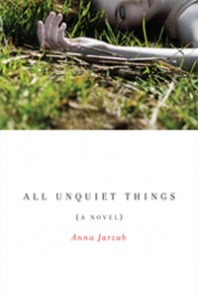
Her debut novel ALL UNQUIET THINGS is slated to be released from Delacorte on January 12, 2010, which I can describe as Veronica-Mars-meets-Clueless.
Interested? Read on. TWFT has scored a very-exclusive interview with her.

TWFT: Summarize ALL UNQUIET THINGS IN 10 words or less.
Anna: Two teenagers set out to find their friend’s real murderer.
(TWFT Note: Here’s the synop.
All Unquiet Things centers around the murder of teen heiress Carly Ribelli, who was found shot to death a mile from her house in a wealthy Northern California suburb. Carly’s uncle, a dissolute alcoholic, was convicted of the crime, but a year later his daughter still doesn’t believe her father is guilty. Determined to prove his innocence, Audrey Ribelli contacts Carly’s ex-boyfriend, Neily Monroe, the boy who found Carly’s body. She is convinced that he knows more than he thinks about the events that led up to Carly’s death. Despite Neily’s initial reluctance, he and Audrey begin their investigation at the posh private school they attend, identifying prime suspects from among their spoiled classmates and digging up secrets about Carly’s past to get to the truth behind her murder.)
TWFT: Did you ever want to be anything besides an author?
Anna: Oh, loads of things. I wanted to be a journalist for a long time, until I took a journalism class in high school and did really poorly in it. That crushed that dream pretty quick. When I started college, I thought I might want to be a lawyer, but that fizzled pretty quickly. From sophomore year of college on, all I wanted to do was work in publishing. And now I do! Seven years later. Oh well, better late than never.
To tell the truth, being an author has always sort of been my secret pipe dream, and I couldn’t believe it came true before my “real” career goals. Boggles my mind every day.
TWFT: When did you start writing?
Anna: I always say I started writing when I was eleven because that’s the year that sticks out in my mind, but I think that’s because eleven is how old Mallory from The Baby-Sitters Club was when she was “writing her novel” and I might have conflated that fact with my own childhood. But! I started writing not long after that. I guess I thought if Mallory could do it, I could do it. I think I finished my first novel in my senior year of high school, though. And boy, was it awful! But I’ve been writing pretty consistently since before I was a teenager, so I’ve had lots of years of practice.
TWFT: What’s your writing process? Do you outline?
Anna: Sometimes I do, sometimes I don’t. I didn’t outline AUT, although I took copious notes, and the book ended up needing so much revision just because things didn’t logically fit together at first. I’m a really intuitive writer, so all my facts don’t exactly line up in the first draft. (Whoops.) Thank God I have a great agent, editor, and numerous copy editors and proofreaders, to make sure that AUT is perfectly continuous. I outlined my next book, MB, and it made it so much easier to write, but now I’m back to not working off an outline in the two books I’m working on now and–surprise!–they’re taking longer and being much harder to write. So I should outline more, but sometimes I get lazy or excited and I just want to jump in to actually writing the thing already without having to do all the prep work. This rarely makes my life easier.
TWFT: Do you have any advice for teen writers?
Anna: Well, there are the normal things, like read as much as you can and write all the time, both of which are pieces of advice given by every author on the planet and also they’re completely true and necessary. I would say, as an additional piece of advice, that it’s important to be wary of creative writing classes. Not to bag on creative writing classes, because I know a lot of people find them helpful, but it all totally depends on the group of people and the dynamic and the teacher and there are so many variables. A lot of times I think that first-time writers, or even long-time writers who are really trying to learn something, can get dragged down and discouraged by how unnecessarily critical and ultimately unhelpful fiction workshops can be. So while I’m not saying, “Never take a creative writing class! They’re horrible!” I rarely got anything useful out of mine, and the atmosphere was not always one of learning but one of posturing and insecurity masked as snobbishness. I think that’s what put me off any interest in critique partners or writing groups once I started getting serious about writing. I guess my point is that you should never let somebody’s need to show off to a famous professor or meanly critique you to death get in the way of your vision and stomp on your creative spark. Take creative writing classes if you want, but don’t take them too much to heart, unless you feel like what’s being said is helpful to you.
Wow, does it sound like I’m a creative writing class trauma victim or what?
TWFT: In your bio, you mention that you actually wrote All Unquiet Things as your thesis project at UChicago. That sounds like an incredible feat of minimizing your workload! How did you manage to get that set up?
Anna: It was part of the program, actually. It was so nice, because I didn’t want to get an MFA but I also didn’t want to write an academic thesis for a Master’s program because I knew I wasn’t interested in going on to get my Ph.D. The Master’s program I did at the U of C has a creative thesis option, which was one of the reasons I went there, and it was the perfect set-up. I had a great preceptor (they’re like the U of C version of camp counselors, but ones who assign you back-breaking philosophy reading)–who just signed with an agent, btw! I’m very excited for him–and a brilliant thesis adviser, and they both were very supportive of AUT in its many stages and encouraged me ceaselessly, which I will always be grateful for. But I also got to take regular Ph.D. level courses in philosophy and literature, which was important to me. Being me, though, I filled all the time I saved by getting credit for AUT by doing an eighteen hour a week internship at a small publishing house. I need to learn how to relax.
TWFT: What inspired you to go with the murder mystery plotline? (Do I smell a fellow CSI fan?)
Anna: I’ve always really loved mysteries, although I’ve never been very good at solving them. But I’m a HUGE Agatha Christie fan, and I blew through all of Mary Higgins Clark’s books in junior high, so it’s always been a genre I enjoyed on a purely reading level. When I wrote AUT version 1, it had a “mysterious element” but wasn’t a full blown mystery. That version was awful, so I decided to abandon it. Less than a year later, I realized how much I missed the characters, and I realized that I could refashion it as an actual mystery. It was a slog, because I’d never written something so plot-intensive before, but I think it’s turned out pretty well. :)
As for CSI, I do enjoy it, though I don’t watch it very often anymore. I’m a big X-Files fan, though, like embarrassingly big, and I spent much of my free time in college watching Law & Order, so those shows must have rubbed off on me. My new mystery show obsession is Bones, but I’m running out of old episodes to watch so the new season better come quickly!
TWFT: What’s next after ALL UNQUIET THINGS? Do you plan to write other genres in the future?
Anna: My book deal was for two books, so the next one is tentatively called MURDER BURGER and should be out sometime in 2011, probably January/February, although we don’t have a firm date. It’s also a mystery, about a teenage boy who disappears mysteriously and the friends who try to track him down. I haven’t started revising with my editor yet, and it looks like it might need a lot of work, so God only knows.
And right now I’m working on what I like to call a “quasi-post-apocolyptic pseudo-mystery” and a smaller family drama. I don’t know if I have the stamina to be a mystery writer long-term, but I think I’ll probably write darker stuff mostly, because that’s where my imagination goes.
TWFT: If the apocalypse were coming tomorrow and you could only choose three books (in the entire world) to keep safe, which ones would you choose?
Anna: This is a hard question, but I think it’d be The Pursuit of Love and Love in a Cold Climate by Nancy Mitford (they count as one because they’re packaged together), Pride and Prejudice, and the complete works of Shakespeare. But these are just books that I would want to read over and over again during the nuclear winter; I guess if I had to think of posterity I’d maybe have to go with some others. I’d still bring Shakespeare, though.
TWFT: Where’s your favorite place to write?
Anna: I wish I had a favorite place. The only place I write is in my tiny little bedroom, but this is New York, there are probably better places. I need to go hunt them down.
TWFT: What’s your favorite flavor jellybean?
Anna: Jelly Belly buttered popcorn.
Thanks, Anna, for taking the time! Here’s Anna Jarzab’s website and blog.
(Check back in January for an ALL UNQUIET THINGS signed book giveaway!)
- linda

Wednesday, August 12, 2009

Author Interview: Courtney Summers


Imagine four years.
Four years, two suicides, one death, one rape, two pregnancies (one abortion), three overdoses, countless drunken antics, pantsings, spilled food, theft, fights, broken limbs, turf wars–every day, a turf war–six months until graduation and no one gets a medal when they get out. But everything you do here counts.
High school.
So begins the recently released YA novel, Cracked Up to Be. It’s a truly wild ride written by one truly wild, not to mention awesome, author. That author is Courtney Summers, and TWFT has snagged an interview with her, so sit back and enjoy…
Hey Courtney! Cracked Up to Be, your debut novel, has gotten some rave reviews and lots of positive attention since its release in December. Eight months after the fact, what insights have you gained on “The Published Life”?
The more I do this, the more I learn (over and over again) that it takes a village to get a book published. It constantly amazes me how many (fantastic, passionate!) people are involved in the process and how hard they work to make the final product absolutely perfect. Every decision is made toward that goal and it defines the way you listen and the way you ask your own questions. Also, publishing works on its own time. Patience is a virtue, both before and after the sale of a book. (Has it been eight months already?! Aaah!)
Okay, it’s more like seven months – I rounded up, so relax… for now! After all that exposure to the publishing world, do you still remember your querying days? What happened on your road to agentdom?
PHEW! Seven months I can deal with! But eight–that’s just crazy. ;) I do remember my querying days. I haven’t deleted a single query I’ve sent from my inbox, actually. My road to agentdom was fairly standard. I wrote the books, I polished the books, I wrote queries for those books and targeted my submissions to agents VERY carefully. Research is essential for querying. The amazing Amy Tipton of FinePrint Literary Management read the query, requested the full and shortly thereafter offered representation and we’ve been happily working together ever since!
Sounds like a happy ending! The book features Parker Fadley, a high school senior who’s gone through some seriously traumatic stuff… and whose happy ending is not so assured. How did you go about developing such a complicated character?
Once I knew what Parker’s problem was, I had her voice. She was very clear to me. And because so much of her attitude is defined by her responses to other characters and the situations around her, my approach was to write her out and see what happened, let her develop with the story. I got some pleasant surprises by doing this–I didn’t pre-plan the finger-snapping, for example. It just happened!
Are there any similarities between yourself and Parker? Finger-snapping, or maybe compulsive hair-combing?
I think Parker and I have the same need for perfection. We are hard on ourselves and sometimes it gets the better of us. But luckily (!), it hasn’t gotten the better of me in quite the same way it got the better of her…!
Good to hear, good to hear. Your second novel, Some Girls Are, is due out in January of next year. Are you more or less excited than you were for the release of your first book? More or less nervous?
I am as excited about the impending release of Some Girls Are, but much more nervous than I was for the release of Cracked Up to Be, which is something I never would have thought possible. Second books are scary; you’ve shaped reader expectations with your first novel and you hope that what you put out next lives up to those expectations. At the same time, you also hope the book is allowed to stand on its own. It’s nervewracking!
Cracked Up to Be utilizes a writing style I haven’t seen before in the YA genre – I’d almost call it “punk minimalism.” (Okay, skip the punk thing, it’s just really cool.) How much of that is Parker’s voice, and how much is simply your personal style? Can readers expect something similar in Some Girls Are?
Thank you so much! That’s definitely my style. I’ve always really, really loved being economical with words. Some Girls Are is similarly spare/minimalist in style, but I feel the voices in each novel are distinctly their own. Where Parker had a biting running commentary going on and avoided her pain by being a total bitch to everyone, Regina (the main character in Some Girls Are) is much angrier and more questioning–she’s a different kind of wounded.
Right now you’re working on your third book, the plot details for which you have kept pretty secret. (I’m all right with that, really. Really.) What has been your hardest challenge in writing this particular novel?
I think the challenge of writing this particular book is that it doesn’t want to be written! And so I am trying to honour its wishes for me to LEAVE IT ALONE and am putting it away for a while and moving onto another idea. I’m simultaneously resentful and excited about this. Resentful because all that time put in, all those pages… it’s hard to let go! Sigh. But excited because I can’t wait to see what challenges the New Book 3 holds. And hopefully the Old Book 3 will become Book 4, because it is a story I’d really like to tell.
Oh wow! I can’t imagine putting all that work aside, but I’m totally sure it will turn out for the better. Did you receive any pressure from your agent or others to finish through with Old Book 3? I’m curious about what stress, if any, new authors are put through to establish their “name” by releasing books quickly.
The only pressure that is put on me is the pressure I put on myself. My agent is incredibly supportive of what I do, and the ideas I pursue. Because book three is not contracted I have the freedom and time to play around with ideas until one sticks and that’s very fun. When you write a book, you make a big commitment to it. It’s not just a one-off. You have to be prepared to spend a lot of time and a lot of work on it. It’s an investment. It is basically a relationship. And no one would ever encourage me to stay in a relationship that didn’t make me happy. :)
(Note: As of Courtney’s recent blog post, Book 3 has been given another chance. You write that thing, girl!)
Has novel writing in general gotten easier as you go along?
I wish! Oh, HOW I wish. Every novel has easy moments, but writing novels is consistently hard. And never hard the same way twice. Or maybe that’s just me… I hope it’s not just me.
What’s your number-one piece of advice to give to aspiring writers?
To just do it and to not let ANYONE talk you out of it. Writing is hard and painful but also wonderful and rewarding. It’s also one of those pursuits that has absolutely no guarantee. When you plan to do something that requires a lot of work and zero guarantees, the first thing other people will do is attempt to talk you out of it. These people generally mean well, but… don’t listen to them. Because life is short and you should be happy. And if writing is what makes you happy, you have to try it. Go straight at it.
If you met up with your sixteen-year-old self right now, what would you say to her? What would she say to you? (Ignoring any possibility of rips in the space-time continuum.)
I have a hard time with these types of questions because–whether or not this is actually the case–I feel like they sort of speak to regret and I generally don’t like doing that. If I told you my answer would be, “Start planning for the zombie apocalypse now!” That probably wouldn’t seem serious enough (although it is very sage!), but if I tried for profound, I’d likely fail. I honestly think I’d just say hello to her, and maybe she would say it back. And then I would stand aside and let her make every single mistake that I know she’s going to make because those mistakes define who I am today, and those mistakes helped me learn and they helped me to grow as a person. And I know my sixteen-year-old self makes it out okay. Mostly all of us do. :)
Your blog has been recognized as one of the quirkiest in the YA blogosphere. Do you think YA authors have a duty to blog, considering their readers? How important is blogging, really?
Those are great questions. Blogging is not for everyone. It’s a committment and it’s time-consuming and it can be hard to think up new content regularly to engage your readers with. You have to invest in it and some people simply can’t. That’s okay. But I do firmly believe that YA authors NEED to have a website at the very least. Nothing drives me crazier as a reader than hearing about a great book and discovering no author website and I honestly can’t imagine why anyone WOULDN’T take advantage of the opportunity to connect with readers in this way. And because I think blogging is a personal choice, I can only tell you that blogging is VERY important to me. I love it. I enjoy entertaining people–or attempting to–with my blog entries and I enjoy engaging with my blog readers. I value their comments and appreciate them taking the time to read the stuff I put out there. It’s a fun way to connect.
Choose one…
An unlimited supply of Ray-Bans OR one completely safe trip into the center of a volcano?
Well, now that I have my ~Lady Gaga~ sunglasses, I would totally take the completely safe trip into the center of a volcano! That would be amazing. All the Ray-Bans in the world could not out-amazing that. They would try, but they would fail.
A day with Edward Cullen OR a day as the hero of a zombie flick?
I have a poster of Edward Cullen in my room. I have a feeling it’s as good as having an actual Edward Cullen around, to be honest. He is quiet, broods and sparkles and sleepstalks me, JUST as he would in real life. So I definitely choose to be the hero of a zombie flick. Although that would be kind of awful because the heroes of those movies are always left with TONS of emotional baggage and about 95% of the people around them die. And usually those people are the people the hero loves the most. Wow. It must suck being a hero in that context. But wait! If it’s a zombie MOVIE none of that emotional baggage is real and the loved ones that die just go off-set, right? In that case: HERO OF A ZOMBIE FLICK ALL THE WAY.
Name your top three favorite plot elements to write:
Secrets, haunted pasts and small towns.
Name the top three loves of your life:
My family, my friends and my pets.
And finally, the TWFT’s most important question: what’s your favorite flavor of jellybean?
GREEN. The best colour AND flavour of them all. I will hear no arguments against this.
Thanks so much for the interview, Courtney! TWFT mission: pick up Cracked Up to Be now and Some Girls Are on January 5th (it’s pitched as Mean Girls meets Heathers). You can read the first chapter of Cracked Up to Be HERE.
~ Emilia

Tuesday, August 4, 2009

Interview with Author Laura Wiess


TWFT was lucky enough to snag an interview with the lovely Laura Wiess, author of books SUCH A PRETTY GIRL, LEFTOVERS, and the recently-released HOW IT ENDS (actually, it’s out today!).
TWFT: Summarize HOW IT ENDS in ten words or less.
Laura: How love ends, begins and discovering loved ones’ dark secrets.

(TWFT Note: This is the actual synop.: All Hanna’s wanted since sophomore year is Seth. She’s gone out with other guys, even gained a rep for being a flirt, all the while hoping cool, guitar-playing Seth will choose her. Then she gets him – but their relationship is hurtful, stormy and critical, not at all what Hanna thinks a perfect love should be.

Bewildered by Seth’s treatment of her and in need of understanding, Hanna decides to fulfill her school’s community service requirement by spending time with Helen, her terminally ill neighbor, who she’s turned to for comfort and wisdom throughout her life. But illness has changed Helen into someone Hanna hardly knows, and her home is not the refuge it once was.

Feeling more alone than ever, Hanna gets drawn into an audio book the older woman is listening to, a fierce, unsettling love story of passion, sacrifice and devotion. Hanna’s fascinated by the idea that such all-encompassing love can truly exist, and without even realizing it, the story begins to change her.
Until the day when the story becomes all too real…and Hanna’s world is spun off its axis by its shattering irrevocable conclusion.)

TWFT: Both LEFTOVERS and SUCH A PRETTY GIRL could be considered edgy YA fiction. Have you experienced any criticism for writing about difficult subjects like child abuse, or has most of the response been positive?
Laura: The reader email for both books has been overwhelmingly positive, and include many personal stories of childhood sexual abuse, the scars left, and the triumph of the survivors. The courage and spirit in these letters is both amazing, and humbling.
Are Such a Pretty Girl and Leftovers for everyone?I don’t know. The stories weave together love and betrayal, terror and desperation, passion and ultimately hope but these girls and the problems they face are not white-washed or sanitized. They’re in trouble and their trouble is real, so finding their way through isn’t always pretty. What I hope the stories are, though, is honest and true to the characters.

TWFT: Speaking of, what draws you to the kinds of (often emotionally heavy) themes you explore in your novels?
Laura: The characters (like Meredith in Such a Pretty Girl or Hanna in How It Ends) who show up (in my mind) wanting something desperately or caught in bad situations draw me in every time, probably because I believe that ignoring the painful, difficult or ugly parts of life doesn’t solve anything or make the issues go away; it only isolates the people going through them, and so I write to discover the why behind the choices we make, and to try and make sense of the way we treat each other.
When my imagination connects with something disturbing – cruelty, abuse and/or neglect of kids, animals and the vulnerable – it pulls me into that dark corner and whispers, Look Laura, pay attention. What if this was you? Yes, it’s terrible and terrifying but just because you don’t want to think about it doesn’t mean someone somewhere isn’t living it right this second. Look, listen, and maybe you’ll learn something.

TWFT: Career-wise, did you ever want to be anything besides an author?
Laura: No. This is my dream career come true.


TWFT: Then what first inspired you to become a writer?
Laura: Reading. There’s nothing I love more than getting lost in a compelling story unless it’s running with great characters, getting totally emotionally involved, learning new truths or views about life and discovering answers for questions I never even knew I had. It’s exhilarating.

TWFT: So if you could bring any fiction character (book/movie/tv) to life, who would it be, and why?
Laura: Just one, when I love so many? This is torture because if I say Anne Shirley, then I can’t say Moll Flanders. If I say the vampire Cole from A.M. Jenkins’ book Night Road, then I’m leaving out Mame Dennis from Auntie Mame or Thomas in Sherman Alexie’s Smoke Signals or James Herriott or Ben in Stephen King’s It or Jamie and Claire in Diana Gabaldon’s Dragonfly in Amber or any one of the thousand other fictional characters I’ve fallen in love with.
You see my dilemma. (I am eternally hopeless this way.)

TWFT: In terms of the unexpected, what are the worst/best thing that have come along with the whole publishing process that you hadn’t foreseen?
Laura: Well, rejection is never fun but it’s always a possibility, so you work hard to make the story the best it can be, wait for an answer and if rejection happens, to deal with it. Also, the timeframe between having a manuscript accepted for publication and how long it takes for the actual book to hit the shelves is useful but at the same time, highly nerve-wracking.
The best parts? Getting a call from your agent with a publishing offer. Opening your box of author’s copies and seeing the story that began in your brain as a tiny spark of a question now in beloved book form. That moment is pure gold. The only thing better is getting an email from a reader that says Wow, I just read your book in one sitting and it totally blew me away. Incomparable.

TWFT: Now for the ceremonial last question: What’s your favorite flavor jellybean?
Laura: I’m really bad at choosing just one of anything (see above) but I think it’s green apple. Or blueberry. Although coconut calls to me, too…


Thanks for the great interview, Laura! You can contact Laura Wiess via her site, her LJ, her blogspot blog, her facebook, or her myspace. You can also order her new book, HOW IT ENDS, on Amazon or B&N.
Or, you know, you could enter the TWFT contest here for a copy.
- linda